


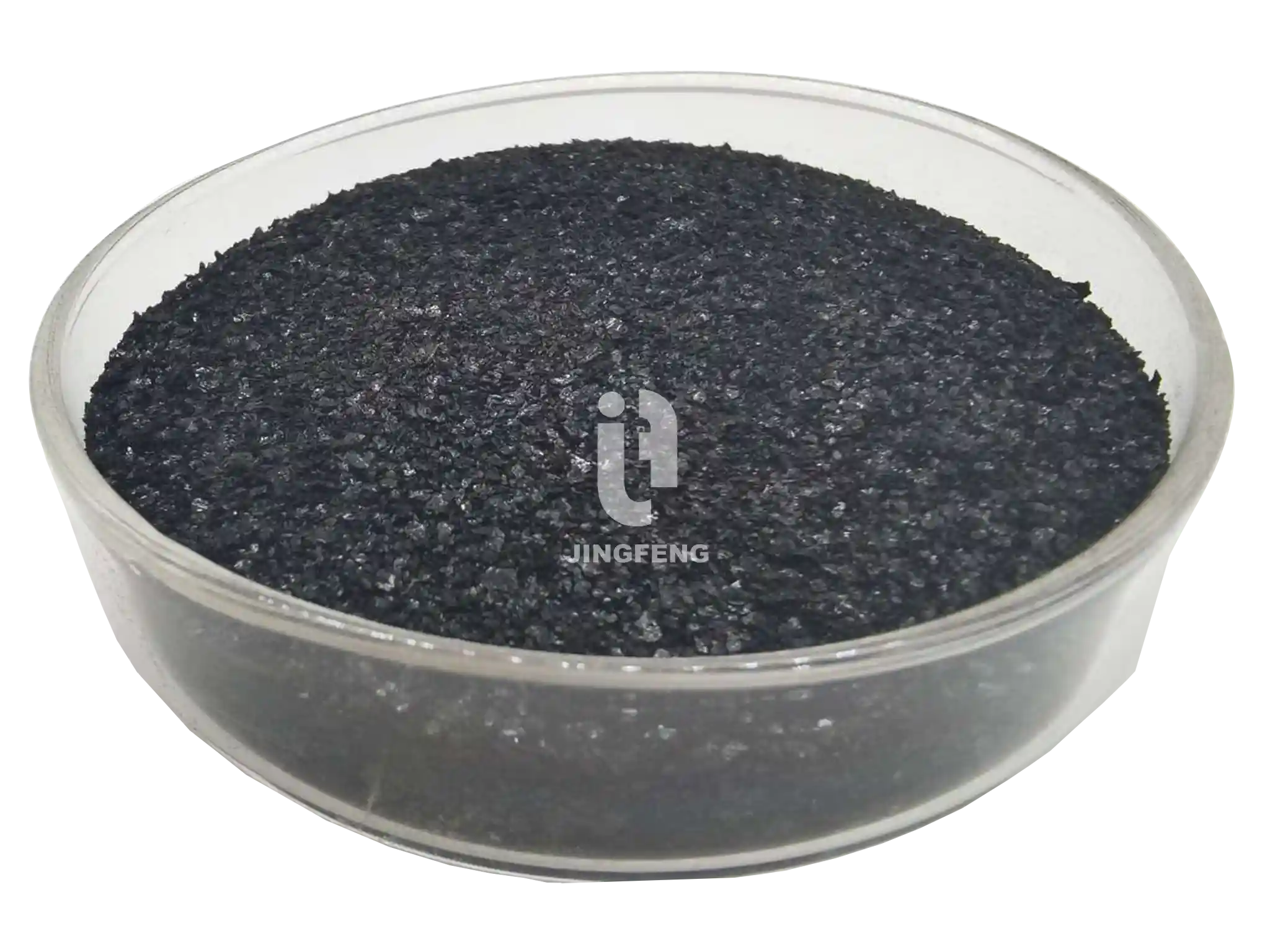
- 1. Potassium Humate Specifications Explained for Bulk Buyers
- 1.1. Key Takeaways
- 1.2. What Potassium Humate Actually Is
- 1.3. The Core Spec Sheet, Decoded
- 1.4. Test Methods You Should Request
- 1.5. Red Flags in a Spec Sheet
- 1.6. Application Notes: Standalone vs. Blendable
- 1.7. Explore the Product
- 1.8. FAQ
- 1.9. Final Word
Potassium Humate Specifications Explained for Bulk Buyers
Key Takeaways
- A potassium humate spec sheet lives or dies on five numbers: humic acid %, fulvic acid %, solubility, pH, and CEC.
- Our Mineral Source Potassium Fulvate Flakes II delivers 65–70% humic acid, ≥20% fulvic acid, and 100% water solubility.
- Always ask for the test method behind every claim (HGT5334-2018, ISO 19822, IHSS, AAPFCO…). Method decides whether two suppliers’ numbers are actually comparable.
- Red flags: vague “humic acid” with no method, low solubility, no lot-traceable COA.
—
What Potassium Humate Actually Is
Potassium humate is the potassium salt of humic substances extracted from mineral-source leonardite (weathered humic coal). It concentrates the humic and fulvic acid fractions and binds them to soluble potassium, giving a product that is easy to dissolve, handle, and apply through irrigation or foliar systems.
For a bulk buyer, the product is only as good as the numbers on the specification sheet — and those numbers are frequently quoted without the method that produced them. This guide decodes the sheet line by line so you can compare suppliers on equal terms.
The Core Spec Sheet, Decoded
| Parameter | What it means | Typical range (quality grade) | Why it matters to you |
|---|---|---|---|
| Humic acid content | The humic-acid fraction (dry basis) | 65–70% (our Flakes II) | The primary active value; drives CEC and soil/plant response |
| Fulvic acid content | Low-MW, highly bioactive fraction | ≥20% | Improves nutrient chelation and uptake efficiency |
| Solubility | % that dissolves in water | 100% water-soluble | Determines whether it clogs drippers or stays in suspension |
| pH (1% solution) | Acidity of working solution | Typically 9–11 (verify on COA) | Affects tank-mix compatibility and crop safety |
| CEC (cation exchange capacity) | Capacity to hold/exchange nutrients | High (large-MW fraction) | Directly tied to fertilizer-use efficiency |
| Moisture | Water content | Low, per COA | Affects net active weight and shelf life |
| Water-insoluble matter | Residue after dissolution | Minimal | High values = clogged lines, wasted product |
Buyer tip: Request the COA (Certificate of Analysis) for the *specific lot* you will receive, not a generic brochure number.
Test Methods You Should Request
Numbers are only comparable when the method is the same. Ask suppliers to state the standard behind each value:
- HGT5334-2018 — Chinese industry standard for humic-acid fertilizers
- ISO 19822 — international method for humic substances
- IHSS — International Humic Substances Society fractionation (the academic benchmark)
- AAPFCO — Association of American Plant Food Control Officials (US labeling)
- HPTA / CDFA — Humic Products Trade Association / California Department of Food & Agriculture
- Colorimetric — quick lab method, less precise than gravimetric/ISS
If a supplier cannot name the method, treat the number as unverified.
Red Flags in a Spec Sheet
- “Humic acid 70%” with no method — could be total organic matter, not humic acid.
- Low solubility (<90%) for a product sold as “fully soluble” — expect line clogging.
- No lot-traceable COA — only a marketing PDF.
- Missing fulvic fraction — cheaper products isolate only humic acid and skip the more bioactive fulvic part.
- Unrealistically low price — usually means diluted or blended filler.
Application Notes: Standalone vs. Blendable
Our Mineral Source Potassium Fulvate Flakes II is formulated as a standalone soil/plant input (foliar spray, drip irrigation, seed treatment, hydroponics, substrate). It is not pre-formulated for direct blending with fertilizers or pesticides — if you need a tank-mix-compatible grade, ask for our complementary *Mineral Source humic fulvic fertilizer* grade instead.
Always run a small jar compatibility test (blend → stir → stand 30 min → stir again) before scaling any blend.
Explore the Product
- Full specification & packaging: Mineral Source Potassium Fulvate Flakes II
- How to apply at the farm level: How to Use Humic Acid on Plants
FAQ
Q1. What humic acid percentage should I specify for bulk potassium humate?
A premium mineral-source grade runs 65–70% humic acid on a dry basis. Below ~50% usually indicates dilution or a lower-grade source.
Q2. Is 100% solubility really necessary?
For fertigation and hydroponics, yes — anything less risks clogged emitters and uneven dosing. For dry broadcast, solubility matters less but uniformity still does.
Q3. Which test method should I trust most?
IHSS fractionation is the academic gold standard; for contract purposes, align on HGT5334-2018 (China), ISO 19822, or AAPFCO (US) and put the method in the purchase spec.
Q4. What is a realistic MOQ and lead time?
See our dedicated guide: Potassium Humate MOQ, Packaging & Shipping (link to be wired on publish).
Final Word
A spec sheet is a contract in numbers. Pin down the method, the lot COA, and the soluble/fulvic fractions, and you can compare any two suppliers on equal ground.


