- 1. What Is Potassium Fulvate and Why It Beats Ordinary Potassium (KCl)
- 1.1. What Is Potassium Fulvate, Exactly?
- 1.2. Potassium Fulvate vs Potassium Chloride (KCl)
- 1.3. Why Growers Switch to Potassium Fulvate
- 1.4. Four Ways to Apply Potassium Fulvate
- 1.5. Example Schedule: Potassium Fulvate for Vegetables
- 1.6. Example Schedule: Fruit Trees
- 1.7. Foliar Potassium Fulvate: Dilution and Timing
- 1.8. Practical Cautions
- 1.9. FAQ
- 1.10. Pair It With Other Biostimulants
- 1.11. The Bottom Line
What Is Potassium Fulvate and Why It Beats Ordinary Potassium (KCl)
Potassium is the “quality nutrient.” It drives sugar transport into fruit, tightens cell walls against disease, and keeps stomata opening and closing so the plant can breathe through heat and drought. Most growers reach for potassium chloride (KCl, “muriate of potash”) because it is cheap — but chloride comes with baggage: it can salt the soil, stress chloride-sensitive crops, and sit there unabsorbed if conditions aren’t perfect.
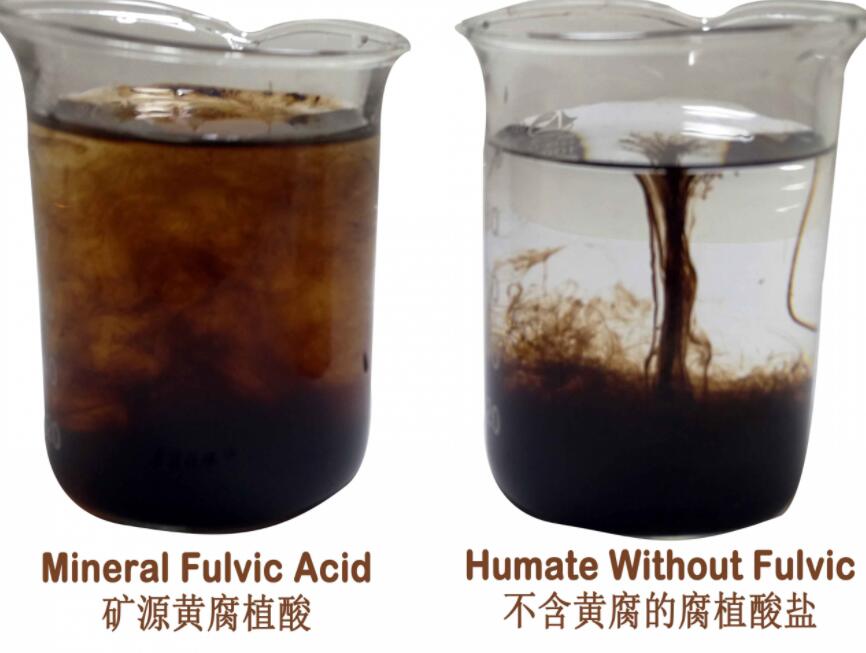
Potassium fulvate is a different delivery system. It is potassium bound to fulvic acid, the smallest, most active fraction of humic substances. The fulvic acid carries the potassium into the plant and into the root zone in a form that is taken up far more efficiently than a bare chloride or sulfate salt. This guide explains what potassium fulvate is, why it outperforms ordinary potassium, and how to use it in vegetables, fruit and field crops.
Full specifications and packaging are on the Potassium Fulvate product page.
What Is Potassium Fulvate, Exactly?
Potassium fulvate is a water-soluble humic-acid powder where potassium is complexed with fulvic acid. In a typical technical-grade material you get roughly 10–12% K₂O wrapped in a matrix that is 50%+ fulvic acid and 100% water-soluble — it dissolves completely with no residue, which matters for drip and foliar systems where any insoluble grit clogs emitters.
The functional difference is the fulvic acid itself:
- Fulvic acid is a natural chelator. It forms small, soluble complexes with potassium (and with micronutrients), keeping them mobile in the soil solution and easy for roots to absorb.
- It is tiny and penetrates. Fulvic molecules are small enough to move through root cell walls and even be taken up through leaves, which is why potassium fulvate works well as both a soil and a foliar input.
- It buffers the root zone. By improving cation exchange and water retention, it helps the plant use the potassium that is already in the soil instead of needing ever-larger dressings.
So “potassium fulvate vs potassium chloride” is really a question of delivery: the same nutrient, carried in a form the plant can actually use.
Potassium Fulvate vs Potassium Chloride (KCl)
| Potassium chloride (KCl) | Potassium fulvate | |
|---|---|---|
| Companion ion | Chloride (Cl⁻) | Fulvic acid (organic) |
| Uptake efficiency | Moderate; chloride can antagonize | Higher; fulvic chelation aids uptake |
| Soil effect | Can raise salinity, harden clay | Improves aggregation, water holding |
| Crop fit | Broad, but risky on chloride-sensitive | Broad, including sensitive crops |
| Best use | Bulk soil K | Foliar, fertigation, quality push |
For a fixed potassium target, fulvate usually returns more of that potassium as yield and quality, because less is locked up or lost. On chloride-sensitive crops — berries, potatoes, citrus, some vegetables — dropping KCl in favor of a chloride-free source is often the single biggest quality lever available.
Why Growers Switch to Potassium Fulvate
- Better potassium uptake. Fulvic complexation means more of the applied K reaches the plant rather than being fixed by the soil.
- Root development. Fulvic acid stimulates root growth and branching, which in turn improves uptake of potassium and everything else.
- Fruit quality. Potassium is the sugar-and-color nutrient; a well-timed fulvate program pushes Brix, uniform coloration, and firmer fruit.
- No chloride stress. Safe on crops that hate chloride, and gentler on saline or tired soils.
- Clean for irrigation. 100% solubility means it runs clean through drip lines and boom sprayers.
Four Ways to Apply Potassium Fulvate
| Method | Dilution / rate | Best for |
|---|---|---|
| Foliar spray | 1:1000–1:1500 (product : water) | Fruit sizing, color, stress periods |
| Fertigation / drip | 1:500–1:1000 | Vegetables, orchards, greenhouse blocks |
| Soil base dressing | Blend with NPK program | Building season-long K reserve |
| Tank-mix with other inputs | Compatible with most fertilizers | Combined biostimulant programs |
Apply foliar sprays in early morning or late evening when stomata are open and evaporation is low. Jar-test any new tank mix on a few plants before a full pass.
Example Schedule: Potassium Fulvate for Vegetables
Vegetables are heavy, continuous potassium feeders, and they reward a steady supply with better fruit set and shelf life.
- Transplant / establishment: light fertigation at 1:1000 to support early root development.
- Vegetative peak: foliar at 1:1000–1:1500 every 10–14 days.
- Fruiting / sizing: increase to weekly foliar plus fertigation to push sugar and uniformity.
This potassium fulvate for vegetables cadence is the one we most often recommend for tomatoes, peppers, cucurbits and leafy greens in tunnel or open field.
Example Schedule: Fruit Trees
Tree fruit wants potassium at flowering and again at fruit enlargement.
- Bud break → flowering: 1–2 foliar passes at 1:1000–1:1500 to support set.
- Fruit enlargement: weekly-to-biweekly foliar plus fertigation through the pivot or drip.
- Pre-harvest: a final foliar pass to lift color and Brix without pushing late vegetative growth.
Foliar Potassium Fulvate: Dilution and Timing
For liquid feeding, dissolve the powder and dilute to roughly 1:1000–1:1500 for foliar, 1:500–1:1000 for fertigation. Spray when the leaf is actively transpiring but not heat-stressed — early morning and late evening are ideal. Avoid midday application, which wastes product to evaporation and risks scorch on tender foliage.
Practical Cautions
- Soil test first. Potassium fulvate improves uptake, but it doesn’t replace a soil that is catastrophically deficient — know your baseline.
- Don’t double up blindly. If you already apply potassium in your base fertilizer, count it toward the season total; fulvate is the efficiency layer on top.
- Sensitive crops: the chloride-free profile makes fulvate safe where KCl is not — but always jar-test new mixes.
- Storage: keep the powder dry; it is hygroscopic and will clump in humid conditions.
FAQ
Can potassium fulvate replace all my potassium?
For most programs, yes as the soluble potassium source. Keep your bulk K in the base dressing and use fulvate for the efficiency-critical foliar and fertigation passes.
Is foliar potassium fulvate enough on its own?
For a quick quality or stress response, foliar at 1:1000–1:500 works fast. For season-long supply, pair it with soil application.
Does it work in drip irrigation?
Yes. At 1:500–1:1000 it runs clean through emitters and pairs well with seaweed extract for a stress-tolerance + quality program.
When should I not use it?
Avoid mixing with strongly alkaline or high-calcium solutions without a jar test, and don’t apply foliar in midday heat.
Pair It With Other Biostimulants
Potassium fulvate stacks naturally with other inputs. Many growers combine it with humic acid urea during the vegetative stage for nitrogen efficiency, then lean on fulvate alone for the fruiting quality push. For a broader program, add seaweed extract during heat or drought stress. See the Potassium Fulvate (JFHA) product page for specifications and packaging options.
The Bottom Line
You don’t need to abandon potassium — you need to make it stick. With potassium fulvate, fulvic-acid-bound potassium is taken up more efficiently than chloride-bound KCl, supports root development, and drives the sugar, color and firmness that define marketable fruit and vegetables. Used as a 1:1000–1:1500 foliar or 1:500–1:1000 fertigation program, it is the cleaner, higher-efficiency way to deliver the quality nutrient.
Rates are starting recommendations and should be adjusted to soil tests, local agronomy advice, and crop needs.
Related reading: the Potassium Fulvate product page for full specifications, our overview of soluble seaweed extract powder for the companion biostimulant, and the Humic Acid Urea page if you want to build a nitrogen-plus-potassium program.